
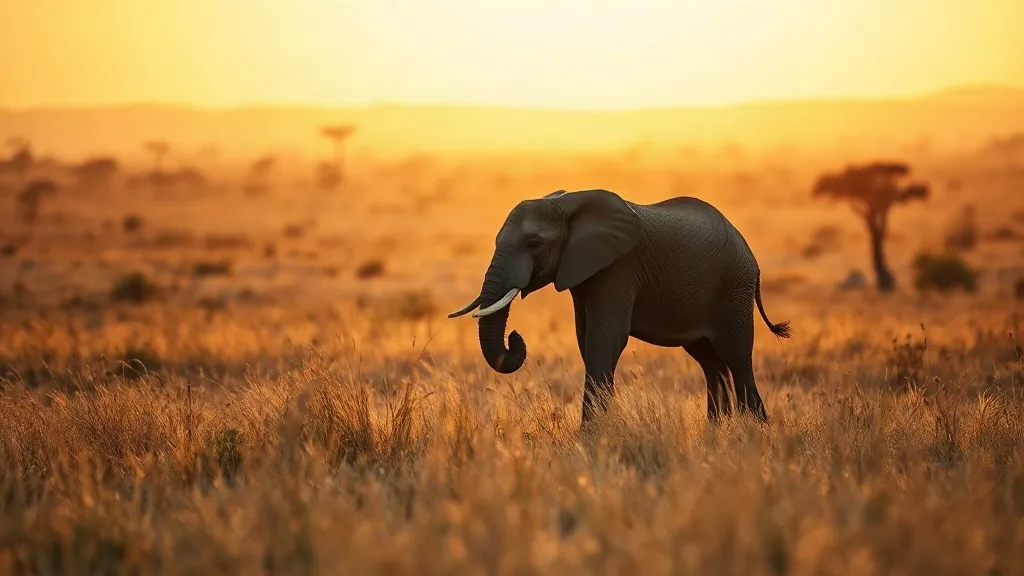
There is a particular kind of silence that settles over a room when a photograph does its work properly. That silence was the first thing many visitors noticed when the Natural History Museum in London began preparing this year's Wildlife Photographer of the Year display, and it is likely to greet the thousands who will file past the prints from 16 October 2026 until July 2027. The image at the centre of that quiet is Federico Veronesi's portrait of an elephant carrying the body of a dead calf, a picture that has taken the overall prize in a competition that has spent six decades refining what it means to photograph the natural world.
Veronesi, an Italian photographer who has spent years working across African savannah and wetland ecosystems, did not set out to make a prize-winning frame. The strength of the photograph lies precisely in that absence of calculation. What he captured is grief, or something close enough to it that the distinction stops mattering, rendered without sentimentality and without spectacle. It is a hard image to look at, and that difficulty is the point.
A Competition That Keeps Redefining Itself
Wildlife Photographer of the Year has never been simply a beauty contest for nature. Since its early decades it has pushed entrants toward harder questions: what does it mean to document a species in decline, to witness behaviour rarely seen, to record the relationship between human infrastructure and the animals forced to navigate it? This year's winners reflect that widening scope across categories that range from underwater photography to urban wildlife, and from photojournalism to mammal behaviour.
The expansion of those categories is not accidental. Aerial and camera-trap technology has changed what photographers can reach, while a generation of image-makers trained in documentary practice has changed what they choose to point their lenses at. The result is a body of work that reads less like a gallery of trophies and more like a field report on the state of the planet.
Why the Winning Categories Matter
Each category in the competition functions as a small argument about what deserves attention. Underwater entries remind viewers that the majority of the ocean remains visually unexplored. Urban wildlife entries force a confrontation with the fact that many species now live primarily in the margins of cities, adapting to noise, light pollution and fragmented habitat. Photojournalism entries carry the heaviest weight, because they often document conflict between human expansion and animal survival, and they rarely offer a tidy resolution.
Mammal behaviour, the category that produced this year's overall winner, is deceptively difficult. It requires patience measured in weeks rather than hours, an understanding of individual animals, and the humility to accept that most days will yield nothing usable. Photographers who work in this space often describe their practice as a form of long-term observation rather than image-making, and the best results carry that accumulated knowledge in every frame.
What Veronesi's Photograph Actually Shows
The elephant in Veronesi's image is carrying a calf that has died. There is no dramatic action, no chase, no confrontation. What makes the photograph exceptional is its composition and restraint: the animal's posture, the way the body of the calf is held, the surrounding landscape that refuses to comment. The picture does not tell the viewer what to feel. It simply presents a moment that most people will never witness and asks them to sit with it.
Elephants are among the few species for which documented responses to death have been widely observed and studied. Researchers who work with them have described behaviours that include standing over a body, touching it with trunks, and returning to particular sites over time. This is not anthropomorphism; it is observation, recorded across multiple populations and contexts. A photograph like Veronesi's lands differently because of that scientific backdrop. It is not a metaphor. It is a record.
The Technical Side of a Quiet Image
Quiet photographs are often harder to make than dramatic ones. Low light, unpredictable movement, and the need to stay at a distance that does not disturb the subject all work against the photographer. Veronesi has spoken in past interviews about the importance of knowing when not to press the shutter, and about the ethics of proximity in wildlife work. The winning frame reflects that discipline. Nothing in it feels rushed, and nothing in it feels staged.
Beyond the Winning Frame: What the Full Selection Reveals
The full set of winning images, which will be displayed at the Natural History Museum from mid-October, covers far more ground than any single photograph can suggest. Underwater entries document species and behaviours that most audiences have never seen, often captured with equipment that has only recently become practical for field use. Urban wildlife entries show foxes, birds, and small mammals negotiating the built environment in ways that are both resourceful and precarious. Photojournalism entries tackle the harder stories, including habitat loss, human-wildlife conflict, and the slow erosion of ecosystems that once seemed permanent.
Seen together, the selection makes an argument that has become central to the competition in recent years: wildlife photography is not a retreat from the world but a way of looking directly at it. The most memorable images are rarely the most beautiful. They are the ones that change what the viewer notices on the walk home.
- The overall winner is Federico Veronesi of Italy, for an image of an elephant carrying a dead calf.
- Winning entries span underwater, urban wildlife, photojournalism, and mammal behaviour categories.
- The exhibition runs at the Natural History Museum in London from 16 October 2026 until July 2027.
Why This Year's Result Feels Different
Every edition of the competition produces a conversation about what wildlife photography should do. Some years the debate centres on digital manipulation and the limits of acceptable editing. Other years it focuses on access, and on whether the field is doing enough to support photographers working in the regions where the most urgent stories are unfolding. This year, the conversation is likely to centre on restraint.
Veronesi's photograph does not shout. It does not rely on a rare species or an exotic location. It asks the viewer to recognise something familiar in an animal that is not human, and it does so without sentimental framing. In a media environment that rewards volume and speed, that kind of image is a small act of resistance. It suggests that the most powerful thing a photographer can do is sometimes simply to be present, and to wait.
For visitors planning to see the exhibition, the experience is likely to be less about individual trophies and more about accumulation. Fifty or sixty images, viewed in sequence, produce a picture of the natural world that no single photograph can carry alone. The dead calf, the urban fox, the deep-sea creature, the contested habitat: each one is a fragment, and the fragments only make sense together.
Frequently Asked Questions
Who won Wildlife Photographer of the Year 2026?
The overall winner is Federico Veronesi of Italy, recognised for his photograph of an elephant carrying a dead calf. The image was selected from a broad field of entries spanning multiple categories.
Where and when can I see the winning photographs?
The winning images will be exhibited at the Natural History Museum in London from 16 October 2026 until July 2027. Visitors can expect the full selection across all categories, not only the overall winner.
What categories are included in the competition?
The competition covers a wide range of categories, including underwater photography, urban wildlife, photojournalism, and mammal behaviour. Each category recognises distinct approaches to documenting the natural world.
Why is this year's winning image considered significant?
The photograph stands out for its restraint and emotional weight. It documents a behaviour that has been observed and studied in elephants without overstating or dramatising the moment, which is part of what makes it memorable.
Is wildlife photography becoming more focused on conservation stories?
Yes. In recent years the competition has increasingly featured work that addresses habitat loss, human-wildlife conflict, and environmental change, alongside traditional portraits and behaviour studies. This reflects a broader shift in how photographers approach the field.