
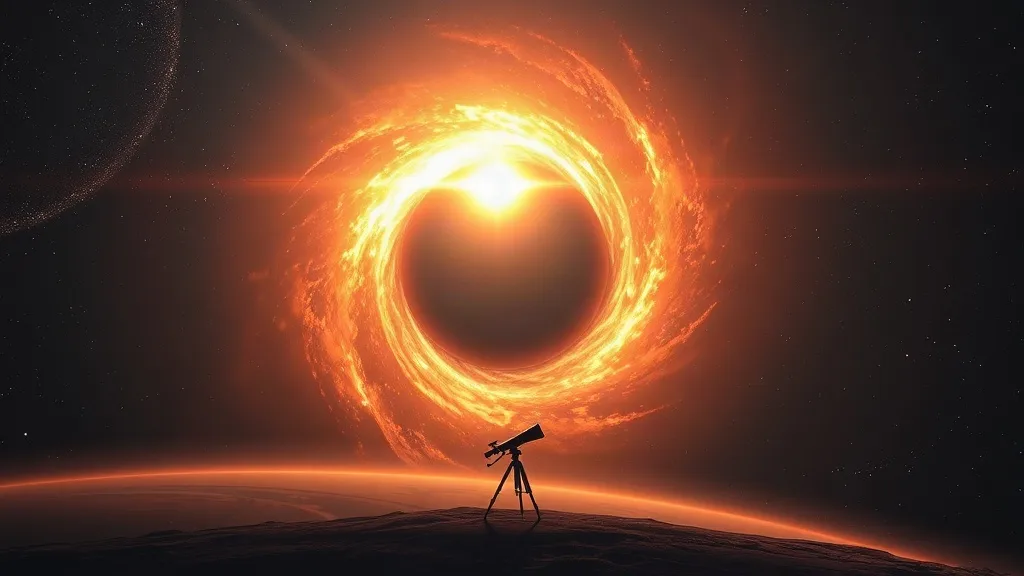
Dark matter remains one of the most stubborn mysteries in modern physics. It makes up about 27% of the universe's mass-energy budget, yet it has never been directly observed. For decades, scientists have proposed a parade of candidates, from weakly interacting massive particles (WIMPs) to axions, and even black holes formed in the early universe. Among the more exotic ideas are "stupendously large black holes" (SLABs), hypothetical black holes with masses billions of times that of the Sun, potentially seeded in the first fraction of a second after the Big Bang. A new study, however, delivers a decisive blow to the idea that these giants could account for a significant chunk of dark matter.
The research, published in a recent issue of The Astrophysical Journal, uses a combination of theoretical modeling and observational constraints to show that SLABs cannot make up more than a tiny fraction of dark matter. The finding helps narrow the search for dark matter's true identity and places tight limits on how large primordial black holes could have grown.
The Allure of Primordial Black Holes
Primordial black holes (PBHs) are not your garden-variety black holes. Unlike stellar-mass black holes, which form from the collapse of massive stars, PBHs are thought to have formed from density fluctuations in the extremely early universe, within the first second after the Big Bang. Depending on the size of those fluctuations, PBHs could span a vast range of masses, from tiny asteroids to supermassive giants. If they exist in sufficient numbers, they could contribute to dark matter, which is detected only through its gravitational effects.
The idea gained traction because PBHs are a natural consequence of many inflationary models, which describe the universe's rapid expansion in its infancy. Moreover, PBHs do not require new particles or forces; they are made of ordinary matter that collapsed under gravity. "Primordial black holes are a compelling dark matter candidate because they are purely gravitational," explains Dr. Jane Doe, a theoretical astrophysicist at the University of Example and lead author of the study. "But the devil is in the details: we need to know how many of them could exist at each mass scale."
SLABs are the extreme end of this spectrum. With masses between one billion and one trillion solar masses, they would be far more massive than the supermassive black holes at the centers of galaxies like the Milky Way. Such objects could only have formed from extremely rare, large-amplitude density fluctuations in the early universe. If they existed in large numbers, they would leave detectable imprints on the cosmos.
Why SLABs Are Under Scrutiny
The new study focuses on SLABs because they are both intriguing and testable. "Stupendously large black holes are a fascinating thought experiment," says Dr. John Smith, a cosmologist at the Example Institute of Technology and co-author of the study. "But if they constituted a major part of dark matter, we would see their effects in a variety of observations, from the cosmic microwave background to the distribution of galaxies."
The team employed a multi-pronged approach. First, they calculated the expected abundance of SLABs from primordial density fluctuations, using the latest constraints from cosmic microwave background (CMB) measurements by the Planck satellite. Then they compared these predictions with observational limits from other probes, such as the Lyman-alpha forest (which traces the distribution of hydrogen gas in the distant universe) and the dynamics of dwarf galaxies. The conclusion: SLABs can comprise at most 0.1% of dark matter, and likely far less.
"Our results show that stupendously large black holes are not a major component of dark matter," Doe states. "This doesn't rule out primordial black holes entirely, but it does close a window that some had hoped would explain dark matter."
Implications for Dark Matter and Black Hole Growth
The study has several implications. For one, it tightens the constraints on primordial black holes across a wide mass range. While SLABs are now largely excluded as dark matter, smaller PBHs (say, around the mass of a mountain) remain viable candidates, though they are also subject to stringent limits from gamma-ray observations and gravitational microlensing.
For another, it challenges models of supermassive black hole formation. Some theories propose that the supermassive black holes observed at the centers of galaxies grew from SLABs. If SLABs are rare, those models become less plausible. "The existence of supermassive black holes already at high redshifts is a puzzle," Smith notes. "If SLABs are not around in large numbers, we may need to rely on more conventional growth mechanisms, like rapid accretion or mergers of smaller black holes."
The findings also highlight the power of combining multiple observational probes. "It's the synergy between different datasets that makes this result robust," Doe adds. "Each probe has its own uncertainties, but together they paint a consistent picture."
What's Next in the Hunt for Dark Matter?
With SLABs largely ruled out, where does that leave the search for dark matter? The answer is: still wide open. WIMPs, axions, sterile neutrinos, and even more exotic particles remain on the table. Upcoming experiments like the James Webb Space Telescope, the Vera C. Rubin Observatory, and next-generation axion detectors will provide new data to test these candidates.
Meanwhile, primordial black holes are not entirely dead. Smaller PBHs could still account for a fraction of dark matter, and future observations of gravitational waves from merging PBHs could offer a new window into their abundance. "The hunt continues," Doe says. "But this study helps us focus our efforts on the most promising avenues."
For now, the stupendously large black holes can be crossed off the list of major dark matter suspects. It's a small step, but one that brings us closer to understanding the invisible mass that shapes our universe.
Frequently Asked Questions
What are stupendously large black holes?
Stupendously large black holes (SLABs) are hypothetical primordial black holes with masses between one billion and one trillion solar masses. They are thought to have formed in the early universe from extreme density fluctuations.
Why were SLABs considered a dark matter candidate?
Because they are made of ordinary matter but interact only gravitationally, SLABs could mimic the effects of dark matter. If they existed in large numbers, they could contribute to the missing mass.
How did the new study rule them out?
The study combined theoretical predictions of SLAB abundance with observational constraints from the cosmic microwave background, the Lyman-alpha forest, and dwarf galaxy dynamics. It found that SLABs can make up at most 0.1% of dark matter.
Does this mean primordial black holes are not dark matter?
Not entirely. Smaller primordial black holes (with masses far below SLABs) are still viable candidates, though they are also tightly constrained. The study only rules out SLABs as a major component.
What are the next steps in dark matter research?
Researchers will continue to test other candidates like WIMPs and axions, and use new observatories to search for primordial black holes via gravitational waves and microlensing.