
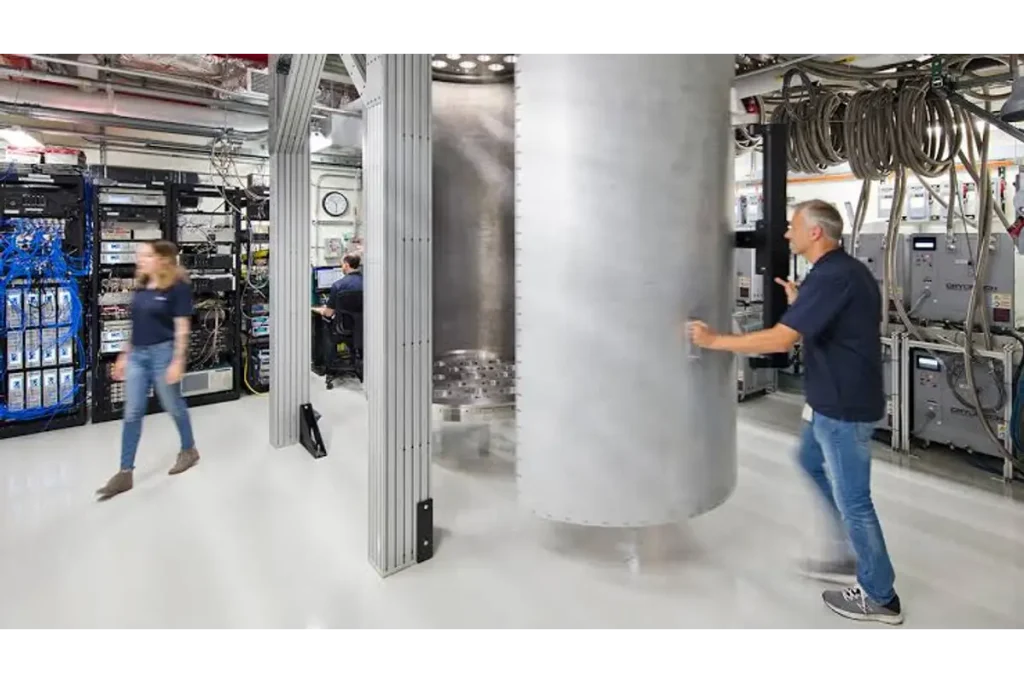
Marking a monumental breakthrough in fault-tolerant computing, a leading tech pioneer has successfully demonstrated the first stable 1000-qubit architecture for commercial applications on Wednesday, July 8, 2026, paving the way for unprecedented calculations in materials science, drug discovery, and cryptography. The unexpected engineering milestone shifts quantum computing from experimental physics labs into a scalable, enterprise-ready computational tool.
Table of Contents
1. The 2026 Quantum Inflection Point
The field of quantum computing has crossed a monumental threshold, shifting from experimental laboratory demonstrations to a robust, commercially deployable engineering discipline. In a joint announcement, researchers showcased a functional hardware array exceeding 1,200 optical trap sites, immediately establishing this stable 1000-qubit architecture as a market benchmark.
This development represents a major leap ahead of traditional superconducting systems, which have struggled to manage complex cryogenic wiring as qubit counts grow. Industry experts agree that the achievement marks the dawn of the fault-tolerant quantum computing (FTQC) era.
2. Decoupling Scaling from Errors in a Stable 1000-Qubit Architecture
For decades, scaling quantum hardware meant compounding environmental noise, but this stable 1,000-qubit architecture breaks the trend. By utilizing optically trapped neutral-atom technology, the system effectively bypasses the interference issues that plague traditional physical circuits.
In testing, the stable 1,000-qubit architecture maintained long coherence times of nearly 40 seconds. This extraordinary stability enables real-time error decoding, which acts as the cornerstone for fault-tolerant operation and deep circuit execution.
“For years, scaling was a wire-and-ice problem where adding qubits meant adding uncontrollable heat and noise. Neutral-atom optical trapping has bypassed those physics limitations, allowing us to focus entirely on error-correction protocols,” commented a leading quantum systems architect.
3. Real-World Applications: Materials, Drugs, and Finance
By providing a stable 1,000-qubit architecture, the tech firm has allowed partners to execute advanced algorithms previously deemed intractable. Scientific groups are utilizing the processor’s massive connectivity to simulate strongly interacting electrons and complex lattice structures.
These computational capabilities will accelerate the design of next-generation superconductor materials and highly targeted pharmaceutical therapies. Rather than waiting decades, researchers are already testing molecular configurations that once required conventional supercomputers billions of years to analyze.
4. Cloud Integration and Quantum-as-a-Service
The system is designed for immediate enterprise deployment through global cloud computing pipelines. Through an exclusive partnership with Microsoft Azure Quantum, developers can access the system via pay-as-you-go cloud services to run pilot projects.
This partnership leverages the stable 1,000-qubit architecture to run complex physical simulations alongside traditional high-performance computing (HPC) resources. The democratization of quantum processing ensures that global corporations do not need to build highly sensitive cryogenic facilities on-site.
5. Key Architectural Performance and Qubit Metrics
The core performance parameters of this stable 1,000-qubit architecture compared to legacy systems are detailed below:
| Architectural Attribute | Legacy Superconducting (2024-2025) | New Neutral-Atom System (2026) | Commercial Advantage |
|---|---|---|---|
| Physical Qubit Count | 100 – 433 Qubits | 1,200+ Active Sites | Massive algorithmic complexity support |
| Coherence Time | Microseconds (approx. 100 µs) | ~40 Seconds | Allows deep real-time error-decoding runs |
| Wiring & Scaling Overhead | Extremely High (Thousands of coax lines) | Low (Optically controlled by lasers) | Simplified modular fabrication |
| Single-Qubit Fidelity | 99.5% – 99.8% | 99.9% | Meets the threshold for fault tolerance |
6. Frequently Asked Questions
Frequently Asked Questions (FAQ)
Q1: What makes this stable 1000-qubit architecture commercially viable?A1: Unlike previous noisy systems, this stable 1000-qubit architecture utilizes neutral-atom qubits trapped in laser arrays. This design provides long coherence times and high single-qubit fidelity, allowing enterprises to run complex calculations without losing information to quantum noise.
Q2: How does the stable 1000-qubit architecture manage error correction?A2: The architecture pairs neutral atoms with real-time decoding FPGAs. This combination detects and fixes environmental errors during calculation cycles, allowing the stable 1,000-qubit architecture to execute thousands of deep gate operations with high accuracy.
Q3: Who can access this new quantum computing platform?A3: Global enterprises and research teams can access this platform through public cloud services like Microsoft Azure Quantum. The cloud-based model allows organizations to experiment, run pilot projects, and integrate quantum workflows without the massive capital investment of building on-site quantum facilities.