
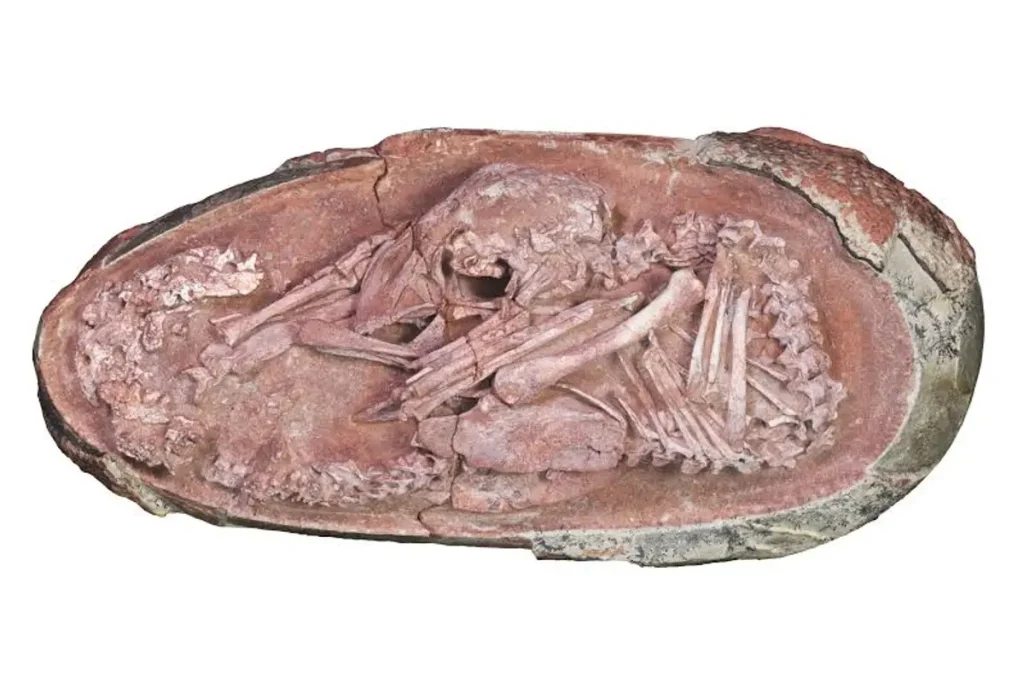
Revealing an extraordinary link between prehistoric reptiles and modern birds, a 70-million-year-old dinosaur embryo found in Argentina was officially detailed by paleontologists on Wednesday, July 8, 2026, offering unprecedented insights into avian-like nesting and pre-hatching behaviors. The delicate fossil was discovered tucked inside a thin-shelled egg that miraculously survived millions of years of tectonic pressure in the Patagonian badlands.
- 1. The Cretaceous Expedition in the Badlands of Neuquén
- 2. A Closer Look at the Dinosaur Embryo Found in Argentina
- 3. How the Fossil Shell Redefines the Avian Evolution Timeline
- 4. Non-Invasive Scanning Tech Unlocks Embryonic Secrets
- 5. Comparing Theropod and Sauropod Embryonic Characteristics
- 6. Frequently Asked Questions
1. The Cretaceous Expedition in the Badlands of Neuquén
The windswept badlands of Patagonia have once again asserted their dominance as a global capital of paleontology. During the live-streamed Cretaceous Expedition I, a team of twenty scientists from CONICET and the Argentine Museum of Natural Sciences made an astonishing find in Río Negro, uncovering a pristine, fossilized egg, which eventually led to the confirmation of the dinosaur embryo found in Argentina.
Initially mistaken for a modern emu egg, the fossil quickly sent shockwaves through the scientific community. Unlike the massive, spherical sauropod eggs common to the region, this specimen exhibited an elongated, asymmetric form that closely mirrors the eggs laid by modern flightless rheas.
2. A Closer Look at the Dinosaur Embryo Found in Argentina
Measuring just a few centimeters, this dinosaur embryo found in Argentina belongs to the small, fast-moving, carnivorous theropod genus Bonapartenykus. This alvarezsaurid dinosaur lived during the late Cretaceous period, approximately 70 million years ago.
Scientists emphasized that a dinosaur embryo found in Argentina in this condition is a geological miracle, given the structural fragility of theropod shells. Because meat-eating dinosaurs had thin, highly porous eggshells to facilitate embryo respiration, their preservation rates in fossil beds are extremely low compared to thick-shelled herbivores.
“To find a theropod egg is incredibly rare. To find one in this state of preservation, with articulated embryonic remains inside, is a once-in-a-career event,” stated vertebrate paleontologist Gonzalo Leonel Muñoz.
3. How the Fossil Shell Redefines the Avian Evolution Timeline
The anatomical features of the egg and its inhabitant provide a direct evolutionary bridge to modern avians. The shell’s micro-structure reveals an asymmetric, multi-layered calcium carbonate composition that is virtually identical to that of modern birds.
Prior to the dinosaur embryo found in Argentina, researchers relied heavily on Chinese theropod specimens to trace avian-like reproductive behaviors, such as nesting in colonies and returning seasonally to specific floodplains. This discovery confirms that Gondwanan theropods had already developed highly sophisticated, bird-like parental instincts and developmental trajectories millions of years before the asteroid impact.
4. Non-Invasive Scanning Tech Unlocks Embryonic Secrets
To analyze the dinosaur embryo found in Argentina without damaging its fragile shell, Dr. Federico Agnolín’s team utilized high-energy micro-CT scanning. This non-invasive technology allowed researchers to construct a 3D digital model of the unhatched creature’s skeletal structure.
The scans revealed that the embryonic skeleton is fully articulated, with the skull featuring a prominent pre-natal “egg tooth” used to crack through the shell. Additionally, the embryo’s curled posture resembles the classic “tucking” position seen in modern chicken eggs shortly before hatching, where the head is brought down under the right wing to maximize hatching success.
5. Comparing Theropod and Sauropod Embryonic Characteristics
The anatomical parameters separating the dinosaur embryo found in Argentina from other fossil groups are compiled in the table below:
| Fossil Group | Shallow-Water / Living Equivalents | Mariana / Patagonian Fossil Species | Extreme Survival Adaptations |
|---|---|---|---|
| Bonapartenykus (Alvarezsaurid Theropod) | Ostrich / Rhea (Avian) | Bonapartenykus ultimus | Tucked posture, thin porous shell |
| Titanosaur (Giant Sauropod) | Crocodilians (Reptilian) | Patagotitan Mayorum | Craniofacial egg-horn, spherical thick shell |
| Modern Rhea / Ostrich | Living Avian Species | Rhea americana | Tucked pre-hatching posture with egg tooth |