
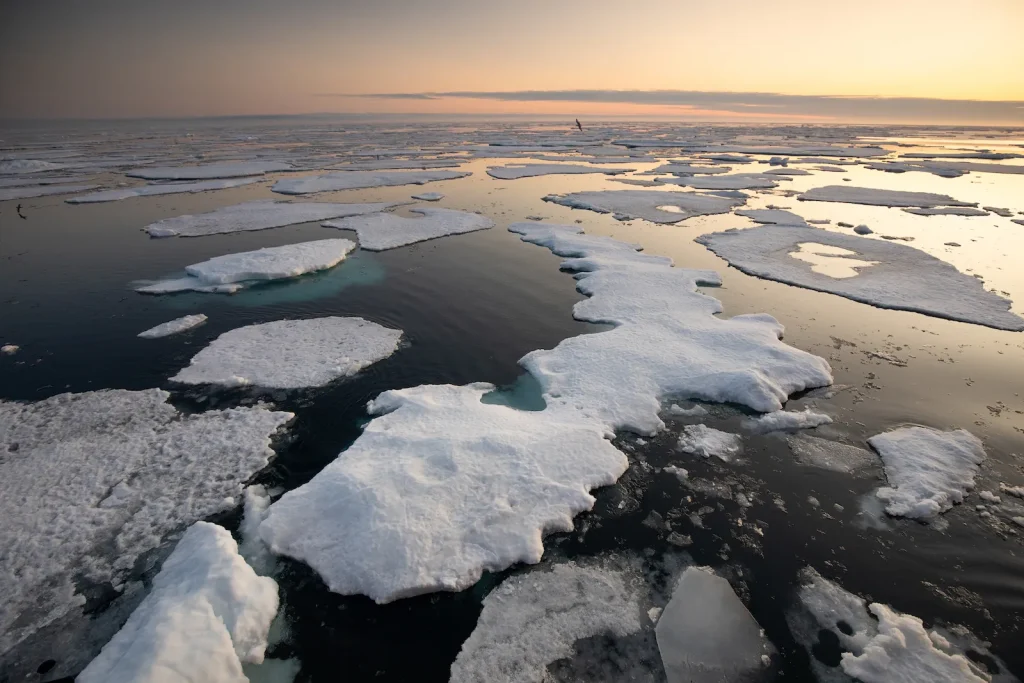
Unveiling a direct meteorological link between polar ecosystems and tropical populations, a groundbreaking study published on Wednesday, July 8, 2026, by international climate scientists has connected accelerated Arctic warming directly to the increasingly erratic and extreme monsoon disruptions devastating South Asia. The findings confirm that polar sea-ice melt alters atmospheric jet streams, which reshapes the timing and volume of essential seasonal rains relied upon by billions of people.
1. The Dangerous Physics of Accelerated Arctic Warming
The fundamental driver behind this global teleconnection is accelerated Arctic warming, which is also known as Arctic amplification. Data from the US National Oceanic and Atmospheric Administration (NOAA) shows that the polar region is heating up to four times faster than the rest of the planet.
As the ice cap shrinks, dark ocean waters absorb more solar radiation, creating a feedback loop that rapidly warms polar air masses. This localized heating alters atmospheric pressure gradients and destabilizes wind networks globally, weakening the delicate planetary cooling system.
2. How Polar Sea-Ice Loss Shakes South Asian Rainfall
According to the landmark study from the Indian Institute of Tropical Meteorology (IITM), early-summer Arctic sea ice melt directly modulates late-summer Indian monsoon rainfall. When polar ice declines in June and July, it triggers an atmospheric response that alters weather systems thousands of miles away.
This mechanism shows that the impacts of accelerated Arctic warming are not confined to empty northern latitudes. Instead, the resulting atmospheric waves shift monsoon moisture westward, bringing extreme deluge events to some regions while plunging others into intense drought. With each passing year of accelerated Arctic warming, late-monsoon phases in India become harder to predict.
3. Analyzing the Jet Stream and Tropospheric Westerlies
The physical connection between these disparate geographic zones is maintained by global wind bands. Researchers found that accelerated Arctic warming weakens the temperature gradient between the equator and the North Pole, slowing down the polar jet stream.
This slower jet stream tends to buckle, allowing cold polar air to escape southward and warm subtropical systems like the South Asian High (SAH) to expand northward. The coupling between these shifting systems acts as a key driver for erratic weather patterns, causing extreme rainfall in some regions and prolonged droughts in others.
“The atmosphere is a single, interconnected fluid. What happens in the Arctic does not stay in the Arctic. Changes there ripple across the entire planet, altering monsoon paths that feed billions of people,” explained a leading researcher during an environmental symposium.
4. The Human and Agricultural Impact in Asia
The social and economic fallout of these shifting weather patterns is already taking a massive toll on agricultural planning. Farmers who rely on the predictability of the southwest monsoon find themselves unable to plan cropping cycles, leading to widespread harvest failures.
For millions of citizens across the Indo-Gangetic Plain, water security is now directly tied to polar changes. Scientists warn that without comprehensive global action to reduce greenhouse gas emissions, these volatile weather shifts will soon become the permanent norm, threatening food security for nearly two billion people.
5. Key Environmental and Meteorological Metrics
The interconnected metrics highlighting the impact of accelerated Arctic warming on global environments are listed in the table below:
| Climate Metric | Historical Baseline | Current Observed Trend (2025-2026) | Atmospheric Impact |
|---|---|---|---|
| Arctic Temperature Rise | Steady gradual warming | 4x global average rate | Weakens polar vortex and atmospheric temperature gradients |
| June-July Sea Ice Extent | Normal summer decline | Lowest levels on satellite record | Triggers thermal anomalies that push subtropical systems northward |
| Jet Stream Speed | Fast and predictable | Slowing and buckling trends | Creates atmospheric blocking over high-latitude zones |
| Asian Summer Monsoon | Consistent rainfall cycles | Unprecedented late-season shift | Triggers intense localized flooding and western droughts |